The life of Guillaume Evangelista
A typographer and Resistance fighter from Cannes, Guillaume Evangelista put his printing press and expertise at the service of the clandestine networks that worked for the Liberation.
Guillaume Ernest
Evangelista
Typographic printer, SOE Resistance fighter, and political deportee from Cannes.
Birth and family
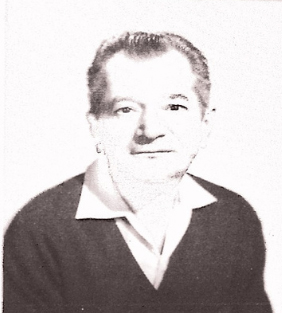
Guillaume Ernest Evangelista was born in Marseille on November 4, 1906. After the death of his wife, his service was deferred and he was sent home to remain with his son.
Military career
He served in Nice in the Chasseurs Alpins, in the 74th Alpine Fortress Battalion, with the rank of corporal. His commitment was later officially recognized under the French Forces of the Interior.
Typographic printer
Director of the Aegitna printing works, located at 27 rue Jean-Jaurès in Cannes, he practiced as a typographic printer and worked notably for many artists.
A life in Cannes
Guillaume resided at the Maison de la Prud’homie in Cannes, in the heart of the city where he practiced his trade and developed his contacts.
In the context opened by General de Gaulle's appeal of June 18, 1940, and by the creation of the Special Operations Executive in London under the impetus of Winston Churchill, clandestine networks gradually formed in France.
Free France was proclaimed despite the French government's attempts to obstruct General de Gaulle's message. Some French people joined London, while others went underground on national territory.
A veritable shadow army was formed. Its members were trained in intelligence, radio transmissions, the manufacture of false documents, the handling of weapons, and the organization of actions against the occupying forces.
The disappearance of the Free Zone allowed the German army to take control of new territories. Resistance networks then had to strengthen their secrecy and their methods of protection.
SOE networks in the South-EastIn Marseille, the networks linked to Maurice Buckmaster were notably organized by Francis Cammaerts, a British Army officer and SOE agent responsible for developing the Resistance in South-Eastern France.
Ange-Marie Miniconi, a friend of Guillaume Evangelista, introduced him to the Jean-Marie Action network, also known as Donkeyman, and then to the networks attached to the SOE.
Guillaume joined the AS24 intelligence service and participated in training within the Fighting French Forces. The networks placed under the authority of Maurice Buckmaster helped prepare Allied operations and the future landing.
The Carte network and various Combat groups on the Côte d’Azur also participated in this clandestine organization. After the Italian occupation, the region passed under the direct control of the German army.
Resistance fighters attempted to obstruct German intelligence services, notably the Abwehr. However, the movement was infiltrated by the Gestapo. Pierre Bertone, a member of the Carte network, was arrested in 1944.
Cannes under the OccupationGuillaume put his trade, his printing press, and his skills at the service of a network in which discretion was a condition for survival.
Guillaume was close to Léon Noël, who was also involved in the Resistance. Arrested by the Germans, the latter was tortured and then murdered.
In Cannes, bombings, denunciations, and arrests multiplied. Several hotels were requisitioned by German services, while their guests could be checked or arrested.
Food became scarce and the population suffered the direct consequences of the Occupation. Several people were killed during bombings, repression operations, or interrogations.
The Hotel Mont-Fleury became one of the places used to interrogate, torture, or murder people suspected of belonging to the Resistance.
The Marsac affair helped provide German services with information on part of the Carte network, facilitating the identification and arrest of several of its members.
The Aegitna printing works at the service of the ResistanceGuillaume Evangelista used the Aegitna printing works to manufacture and distribute clandestine documents. He notably printed the Combat newspaper, leaflets opposing Hitler and the Nazi regime, posters, false papers, as well as various certificates for Resistance fighters.
The printing works became an important point of the clandestine organization in Cannes. The documents produced there allowed Resistance fighters to move around, conceal their identity, and continue their activities.
In 1942, Karl Klaus and Alfred Semisch arrived in Cannes. Among the most feared agents was also Ernst Dunker, known as Delage, a convicted criminal who became a non-commissioned officer of the SIPO-SD, Section IV.
Based in Marseille, Ernst Dunker was associated with the hunt for Resistance fighters as well as numerous acts of torture, violence, and execution.
Interrogations and torture were also practiced at the Gallia, presented as one of the headquarters of the OVRA in Cannes.
The arrest of January 7, 1944Denounced for his clandestine activities, Guillaume Evangelista was arrested on January 7, 1944, by the Marseille Gestapo.
He was accused of treason against the Nazi regime and taken to the Hotel Mont-Fleury. According to preserved reports and testimonies, the interrogations were accompanied by beatings and violence.
The printing works staff was also interrogated. Guillaume ultimately remained alone in the hands of the Gestapo and refused to provide the expected information.
Failing to obtain answers, the German services transferred him to the Baumettes prison in Marseille. His sister and son managed to see him while his face still bore the marks of the beatings received.
Compiègne and the departure for the campsGuillaume was then transferred to the Compiègne-Royallieu camp, where he received the prisoner number 36307. Considered an enemy of the Nazi regime, he was prepared there for his transfer to German labor camps.
Shaved, dressed in a simple uniform and wearing wooden clogs, he had to work for long days while receiving insufficient food.
Prisoners were woken up around three in the morning. Roll calls could last several hours, in the rain, the cold, or the sun. Another roll call awaited them upon their return from work.
These conditions were intended to exhaust the prisoners physically and mentally even before their transfer to the major concentration camps.
Neuengamme, Sachsenhausen and LichterfeldeGuillaume was deported to Neuengamme on June 7, 1944. He was then transferred to Sachsenhausen on July 2, 1944, where he was registered under the number 84377.
Archives mention him notably by means of a Hollerith-Vorkarte card, used to organize and plan the assignment of prisoners within the German war economy.
Guillaume was finally sent to the Lichterfelde kommando, keeping his prisoner number. He continued forced labor there until the liberation.
Throughout his deportation, he endured hunger, violence, disease, endless roll calls, and the systematic exploitation of prisoners by the concentration camp administration.
Liberation and the return to CannesFrom Compiègne to Lichterfelde, Guillaume was reduced to a number and subjected to a system organized around forced labor, exhaustion, and terror.
Upon his release from the camps, Guillaume Evangelista weighed only 36 kilos.
The Red Cross had to treat him and gradually refeed him before he could undertake his return to Cannes.
He would retain serious physical and psychological after-effects throughout his life due to the torture, deprivation, forced labor, and his various internments.
His silence about this period, shared by many former deportees, would partly explain the long research work later undertaken by his daughter to reconstruct his journey.
Honors and DistinctionsGuillaume Evangelista is recognized as a Resistance deportee and member of the SOE. His decorations honor his courage, his discretion, and his commitment to the service of France and its liberation.
He notably received the Legion of Honor, the 1939-1945 Croix de Guerre, the Resistance Volunteer Combatant's Cross, the Medal of Liberated France known as the Intelligence Star, the Medal of Deportation and Internment for acts of Resistance, as well as the Volunteer Combatant's Cross.
His journey is also recognized abroad, notably by the Foreign Veteran USA Medal and by various official correspondences from the United Kingdom.
The letter from the British monarchy and other preserved correspondences testify to the recognition given to his commitment within the Special Operations Executive networks.
On October 18, 2024, the Gold Cross of Mont-Valérien was awarded to him posthumously. A bronze palm was also placed on his grave at the Grand Jas cemetery in Cannes.
His distinctions perpetuate the memory of a man who put his trade, his freedom, and his life at the service of the Resistance and the Nation.

